Coffee-to-Water Ratio: A Measured Starting Point
Use ratio as a repeatable starting point, then record one adjustment at a time for the brewer and coffee in front of you.
A coffee-to-water ratio expresses the mass of dry coffee compared with the mass of brew water. It makes a recipe scalable and easier to repeat, but it does not guarantee flavor. Grinder setting, coffee, brewer, filter, water approach, temperature behavior, contact, and technique can all change the result.
The safest way to use ratio is as a recorded starting point. Weigh both inputs, follow the brewer’s instructions, taste when the beverage is safe, and change one variable at a time.
Equipment boundary: A general recipe never overrides the brewer or machine manual. Respect minimum and maximum fill levels, basket capacity, thermal precautions, assembly instructions, and approved operating modes. Do not force a ratio into equipment that cannot safely hold it.
Read ratio notation correctly
A ratio written as 1:n means one unit of coffee mass for every n units of water mass. If the recipe uses grams, both sides should remain in grams. That consistency avoids mixing a mass input with a volume input and then treating the result as precise.
To find water mass from a chosen coffee mass:
water mass = coffee mass × ratio number
To find coffee mass from a chosen water mass:
coffee mass = water mass ÷ ratio number
Use a calculator rather than mental estimation when scaling. Round only to a level your scale and workflow can actually reproduce. False precision adds digits without adding control.
This article intentionally does not name one mandatory ratio. The Specialty Coffee Association reference offers standards context, but a published reference should not be transformed into a universal personal-taste law. Brewer design and intended beverage style still matter.
Decide which input is the constraint
A recipe can begin from the amount of coffee available, the brewer’s usable water capacity, or the desired serving amount. Choose one constraint before calculating.
If the brewer has a maximum fill line, leave the required operational space and remain within the manual. If the basket or filter has a documented coffee limit, do not exceed it to preserve a preferred ratio. If the desired beverage amount is the goal, remember that input water and finished beverage mass are not automatically identical; coffee retains water and some brewers retain liquid.
Record whether the water figure means water added or beverage collected. Those measurements answer different questions. A log that silently switches between them will appear inconsistent even when the brews were performed correctly.
A measured starting workflow
- Identify the equipment. Confirm capacity, filter, assembly, and operating instructions.
- Choose the ratio for the trial. Note where it came from: brewer guidance, a coffee recipe, or your prior log.
- Choose the constrained input. Start from coffee mass or water mass, then calculate the other.
- Measure dry coffee. Use a stable scale and record the displayed mass.
- Measure brew water. Use the same unit and distinguish water added from beverage collected.
- Record grind and process. Ratio alone cannot reproduce the brew.
- Brew consistently. Keep the filter, pouring or machine program, and contact sequence stable.
- Observe and taste. Note strength, clarity, bitterness, acidity, texture, and sediment separately.
- Select one next change. Decide whether the issue is concentration or extraction character before moving anything.
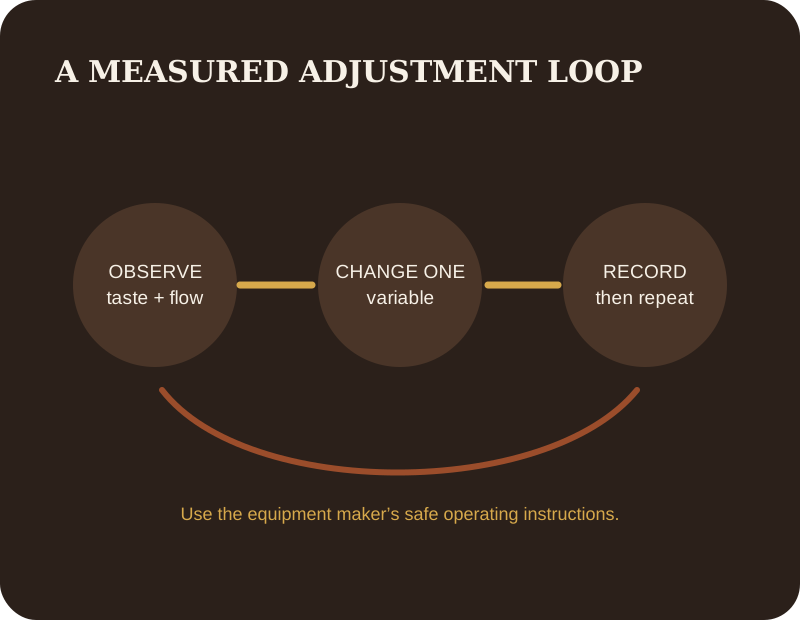
Strength and extraction character are not the same problem
A cup may seem too intense because it is concentrated, because it has a strong roast character, or because bitterness and dryness dominate. A cup may seem weak because it is dilute, because aroma is muted, or because extraction is incomplete. Ratio directly changes the concentration relationship, while grind and contact can strongly change what is extracted.
Before changing ratio, finish this sentence: “I want the next cup to be more or less ___.” Use a specific term such as concentrated, bitter, acidic, clear, heavy, or sediment-heavy. If the concern is simply concentration, a deliberate ratio change may be informative. If the concern is extraction character, hold ratio stable and test grind or process instead.
Avoid making both changes together. More coffee and a finer grind may move several sensory properties at once, leaving no clear explanation.
Scale a recipe without changing its relationship
To make a larger or smaller batch with the same ratio, multiply or divide both coffee and water by the same factor. Then check equipment capacity before brewing. Preserving the mathematical ratio does not guarantee that the larger batch behaves identically; bed depth, flow, agitation, heat retention, and machine programming can change with scale.
Treat a scaled recipe as a new controlled trial. Keep the same coffee, relative grind starting point, filter type, and process where practical. Record any process changes required by the brewer. If the larger batch behaves differently, adjust one variable rather than claiming the ratio calculation failed.
For batch machines, use the maker’s markings carefully. Cup labels on a reservoir are not necessarily the same as a standard measuring cup or the mass you intend to record. Weighing the actual water input avoids ambiguous labels, provided the method is safe for the equipment.
Use ratio across different methods cautiously
A ratio that works in one brewing method is not automatically transferable to another. Pour-over, batch drip, immersion, and espresso manage water and coffee differently. Filters retain different material, pressure and flow differ, and the final beverage may include dilution.
For immersion, write down whether all water is present during the full contact period and how the coffee is separated. For pour-over, record the water-addition sequence and total drawdown as observations. For espresso, distinguish dry dose, beverage mass, and any later water or milk added. A final drink recipe should not be confused with the extraction ratio used to produce the espresso.
If a concentrate is later diluted, record both stages. “Coffee-to-water ratio” could otherwise refer either to brewing the concentrate or to preparing the served drink.
One-variable adjustment paths
If the cup is more concentrated than desired
Keep grind, contact, coffee, and brewer stable. Choose a modest ratio change that uses more water per unit of coffee or less coffee for the same safe water input. Recalculate, brew, and compare. Do not exceed equipment capacity.
If the cup is less concentrated than desired
Choose a modest change in the opposite direction while remaining within basket and brewer limits. Record the exact inputs. If flow or operation becomes abnormal, return to the supported recipe range.
If concentration seems right but taste does not
Hold ratio fixed. Examine grind, contact, water-addition technique, filter, cleanliness, and equipment state. Select one supported change. Ratio cannot diagnose every sensory problem.
If two brews differ despite the same ratio
Check actual masses, grinder setting, coffee identity, filter, process, contact observation, and equipment assembly. “Same ratio” is not “same recipe” unless the other meaningful variables also match.
Troubleshooting before recalculating
- Scale reading changes: confirm the scale is stable, on a suitable surface, and used within its instructions.
- Unexpected overflow: stop and follow equipment safety guidance; verify capacity and assembly before another brew.
- Batch tastes different: check grind, filter, coffee, and process, not only ratio.
- Water figure seems wrong: identify whether the log records water added or beverage collected.
- Recipe does not scale cleanly: verify both inputs were changed by the same factor, then consider brewer behavior at the new batch size.
- Results drift over time: note coffee changes, cleaning, grinder calibration, and technique. Do not assign the change to ratio without evidence.
Pre-brew checklist
- Exact brewer instructions reviewed
- Safe capacity and filter confirmed
- Ratio notation understood
- Coffee and water use the same mass unit
- Constrained input selected
- Calculation checked
- Grinder setting recorded
- Brewing process written down
- Water added distinguished from beverage collected
- Only one planned adjustment identified
Brew log template
| Field | Entry |
|---|---|
| Date and coffee | |
| Brewer and filter | |
| Ratio | |
| Dry coffee mass | |
| Water mass added | |
| Beverage mass, if measured | |
| Grinder and setting | |
| Process and time observations | |
| Taste and texture notes | |
| One next change |
The log should capture what happened, not what was intended. If the measured input differed from the planned value, record the measured value and note the deviation.
Frequently asked questions
What is the best coffee-to-water ratio?
There is no evidence-safe universal answer for every coffee, brewer, and preference. Start with documented guidance appropriate to the method, measure it, and adjust one variable after tasting.
Should I measure coffee by tablespoons?
Volume measures can vary with bean size, grind, and how the spoon is filled. Mass makes a ratio easier to repeat. If a manual uses volume, follow its safe operating instructions while recording mass where practical.
Is water input the same as brewed coffee output?
Not necessarily. Coffee and equipment can retain water. Label each measurement so the ratio is not confused with beverage yield.
Can I make coffee stronger by grinding finer?
Finer grinding may change flow and extraction, but it is not a direct substitute for changing concentration ratio. Decide whether the issue is concentration or extraction character, then change one relevant variable.
Must I keep the same ratio when making a larger batch?
Keeping it preserves the input relationship, but the brewer may behave differently at another scale. Stay within capacity and treat the scaled batch as a new trial.
How precise should the numbers be?
Use precision your scale and routine can reproduce. Extra decimal places are not useful if the equipment cannot resolve them consistently.
Sources and decision limit
The existing Specialty Coffee Association link provides standards and research context. It does not establish one ratio as mandatory for every brewer or taste preference. The equations here are transparent scaling tools, while all safe capacity and operation questions remain with the equipment maker.