How to Dial In Espresso With a Simple Brew Log
Set a baseline, measure the beverage and change one variable per round without pretending a universal recipe fits every coffee.
Dialing in espresso means moving from a repeatable baseline toward a cup that suits the coffee and the drink being prepared. Measurement reduces uncertainty, but it does not create one universal recipe. A dose, beverage mass, or elapsed time useful on one machine and basket may not transfer to another.
The core method is simple: record the recipe, prepare it consistently, observe the shot, taste safely, change one supported variable, and repeat. A brew log preserves the comparison when memory cannot.
Equipment boundary: Use the machine, grinder, basket, and scale only within their manuals. Respect basket capacity, grinder adjustment procedures, warm-up and flushing instructions, hot-surface warnings, and cleaning requirements. Stop dialing in if the equipment behaves abnormally.
Define the variables before changing them
A practical espresso log separates inputs, process, and outputs.
Inputs include coffee identity, dry dose, grinder setting, basket, and supported machine settings. Process includes puck preparation, machine warm-up state, and how the shot is started and stopped. Outputs include beverage mass, elapsed time, visible flow observations, and taste.
Keep the terms specific. “Yield” can be misunderstood, so label the field “beverage mass.” “Time” should state the chosen start and stop points and use them consistently. The purpose is not to prove that one timing convention is correct; it is to make successive entries comparable.
Do not infer extraction quality from appearance alone. Color, flow pattern, and crema can be observations, but the coffee, age, equipment, and recipe influence them. Taste and repeatability remain necessary.
Prepare the equipment baseline
Before using coffee, confirm that the machine is assembled, warmed, and operated as its manual directs. Check that the water reservoir and drip tray are in their normal states, the basket is the intended one, and user-serviceable paths are clean. A descale or cleaning alert belongs in maintenance, not recipe compensation.
Confirm the grinder setting procedure. Some grinders require operation during certain adjustments. Record the current setting in the grinder’s local units; do not translate it to a universal number.
Use a scale on a stable surface and within its limits. If the cup and scale do not fit safely under the group, use a supported setup rather than balancing equipment. Keep hands clear of hot water, steam, and metal surfaces.
Write the baseline recipe
Choose a starting recipe from guidance appropriate to the coffee, basket, and machine. Record:
- coffee name or bag identifier;
- dry coffee mass;
- grinder and local setting;
- basket and portafilter configuration;
- supported temperature or pressure-related setting, if user-adjustable;
- beverage mass target;
- elapsed-time convention;
- distribution and tamping sequence;
- warm-up or flushing state specified by the machine.
A baseline is not a claim that the recipe is optimal. It is a stable point from which changes can be interpreted. If the dose exceeds the basket or machine guidance, choose a supported dose rather than forcing the puck to fit.
Make preparation repeatable
Small preparation differences can change flow enough to hide a grind adjustment. Use the same dosing and distribution sequence each round. Keep the basket dry or prepared according to the machine instructions, and avoid striking or modifying components in ways the maker does not support.
Level and tamp with a consistent process rather than chasing an unverified force number. The aim is to reduce obvious variation. Confirm that the portafilter locks in normally; resistance, leakage, or contact inconsistent with the manual is a reason to stop and inspect dose and assembly.
Purge or flush only as documented. A generic instruction to flush for a certain time cannot apply safely to every heating system or machine mode.
Measure the shot
Tare the cup if the scale workflow calls for it. Start timing at the chosen point and keep that convention for every comparison. Stop at the intended beverage mass using the controls available on the machine.
Record actual values, not merely targets. If the shot was meant to stop at one mass but overshot, enter the observed mass and mark the deviation. Note uneven flow, interruption, machine messages, or unusual sounds without treating them as a sensory diagnosis.
Taste only when safe. Stirring the beverage, if part of the chosen evaluation routine, should be done consistently. Write separate notes for concentration, sweetness, acidity, bitterness, texture, and finish. Not every category needs a strong impression; “not clear” is better than an invented note.
Choose the first variable logically
Grind is often the first adjustment when dose and target beverage mass are suitable and flow is far from useful. A finer setting commonly adds basket resistance; a coarser setting commonly reduces it. Make a small change that the grinder supports, then repeat the same preparation.
Beverage mass is another deliberate variable. Holding dose and grind stable while stopping at a different mass changes the recipe and can help distinguish concentration from extraction character. Do not change grind and beverage mass in the same round if the goal is learning.
Dose should generally remain stable during early grind comparisons, provided it is appropriate for the basket. Changing dose also changes puck depth and recipe relationships, which complicates the result. Machine settings should be changed only when the manual supports them and simpler causes have been controlled.
Use taste as structured feedback
A shot that seems sour, bitter, thin, heavy, drying, or muted does not identify one cause by itself. Coffee character, roast, concentration, temperature behavior, cleanliness, and preparation all contribute.
Ask three questions:
- Was the shot prepared and measured as intended?
- Is the main concern concentration, extraction character, texture, or a coffee characteristic?
- Which single supported change most directly tests that concern?
If the beverage is both unusually fast and sharp compared with a stable baseline, a finer grind may be a reasonable test. If it is unusually slow and harsh, a coarser setting may be reasonable. Those are hypotheses, not diagnoses. Pull the comparison shot before drawing a conclusion.
The one-variable dialing loop
- Record the complete baseline.
- Pull and measure the shot.
- Taste and name the primary concern.
- Choose one variable: normally grind or beverage mass during early rounds.
- Make a modest supported change.
- Repeat the same dose, preparation, and machine state.
- Compare with the immediately previous shot.
- Keep, reverse, or refine the change.
- Stop when the cup is enjoyable and repeatable.
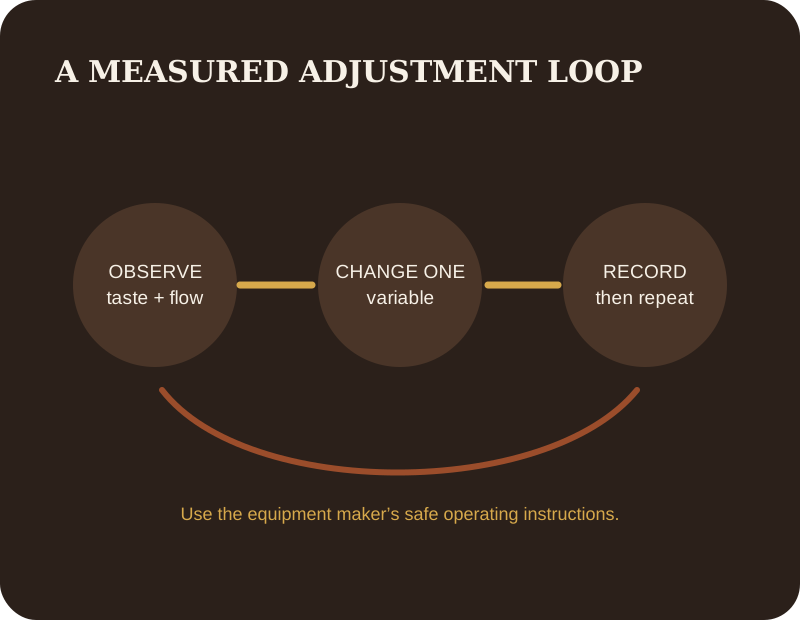
Do not discard an unsuccessful entry. It marks a boundary and prevents the same guess tomorrow.
Troubleshoot inconsistency before taste
If two nominally identical shots differ substantially, dialing by flavor alone will be inefficient. Check one category at a time:
- Dose: verify actual dry mass and whether grounds were lost in transfer.
- Setting: confirm the dial did not move and the adjustment procedure was followed.
- Distribution: repeat the same steps and look for obvious preparation changes.
- Basket and portafilter: confirm they are clean, undamaged, and seated as directed.
- Machine state: follow warm-up and operating instructions; note alerts.
- Coffee: confirm the same bag and storage context.
- Scale and stopping: verify the cup was tared and actual beverage mass recorded.
When preparation becomes repeatable, return to the one-variable loop. If the machine leaks, fails to reach normal operation, produces errors, or sounds abnormal, stop and use manufacturer troubleshooting.
Know when to stop
A useful home recipe does not need to match a competition or café target. Stop when the cup works for its intended drink and can be repeated without excessive waste. Write down the final range rather than pretending one decimal or second is permanent.
Coffee can change over time, and grinder cleaning or adjustment can shift the local setting. Begin future sessions from the last useful recipe, pull a measured verification shot, and change only if the result calls for it.
If the espresso will be combined with water or milk, evaluate the finished drink as well as the straight shot. A recipe preferred straight is not automatically the preferred base for every drink.
Dial-in checklist
- Machine and grinder manuals reviewed
- Equipment clean and operating normally
- Basket and supported dose selected
- Coffee and water context stable
- Dry dose measured
- Local grind setting recorded
- Preparation sequence consistent
- Beverage mass and elapsed time recorded
- Taste described in separate attributes
- One variable chosen for the next shot
- Final useful recipe saved
Brew log template
| Field | Entry |
|---|---|
| Date and coffee | |
| Machine and basket | |
| Dry dose | |
| Grinder and setting | |
| Machine setting/state | |
| Preparation notes | |
| Beverage mass | |
| Elapsed time and convention | |
| Flow observations | |
| Taste and texture | |
| Single change from prior shot | |
| Decision for next shot |
Frequently asked questions
What numbers should I use to dial in espresso?
Start with guidance appropriate to the coffee, basket, and machine rather than a universal number. Record dry dose, beverage mass, elapsed time, and grinder setting, then adjust from the observed cup.
Should I change grind or dose first?
If the dose is suitable for the basket, holding it stable and adjusting grind often creates a clearer comparison. Change dose deliberately only with a reason and within equipment guidance.
Is shot time the target?
Time is useful evidence, not a complete quality verdict. Define the timing convention, keep it consistent, and interpret it alongside beverage mass, preparation, and taste.
Why do identical settings produce different shots?
Actual dose, distribution, tamping process, machine state, coffee, retained grounds, and stopping accuracy may differ. Audit the routine one factor at a time before moving the grinder.
Can I dial in without a scale?
You can prepare espresso, but an unmeasured workflow gives less information about what changed. A compatible scale makes dry dose and beverage mass visible. Never place a scale where it creates instability or conflicts with machine instructions.
How many shots should dialing in take?
There is no responsible universal count. Starting accuracy, equipment, coffee, and the size of each change matter. Stop when the result is useful and repeatable, not when an invented quota is reached.
Sources and decision limit
The existing Specialty Coffee Association reference provides standards context, not a universal home espresso recipe or compatibility claim. This workflow uses transparent measurement and cautious hypotheses. It does not claim firsthand testing.