Why Espresso Tastes Bitter: Diagnose Before Chasing the Grind
Separate coffee character, recipe, temperature, flow and cleanliness before making one measured adjustment.
Bitterness is not proof of one specific espresso fault. It can reflect the coffee’s roast and composition, beverage concentration, extraction, machine state, stale residue, water context, or the taster’s language. A grinder change can help in some cases, but changing it before recording the recipe turns a clue into a guess.
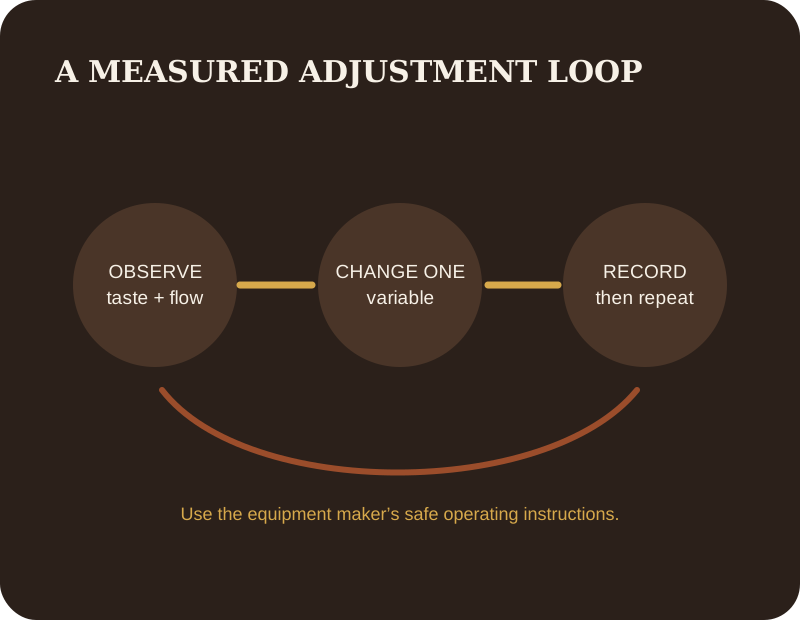
The evidence-safe approach is to establish a baseline, confirm normal equipment operation, describe the cup precisely, and change one supported variable. The next shot becomes a comparison rather than a restart.
Equipment boundary: Follow the exact machine and grinder manuals for warm-up, basket capacity, adjustment, cleaning, backflushing, descaling, and hot-surface precautions. Stop recipe troubleshooting when there are leaks, errors, abnormal sounds, damaged parts, or other signs that service guidance is needed.
First, confirm that “bitter” is the right word
Taste vocabulary differs. One person’s bitter may be another person’s dark-roast intensity, dryness, smoke, or high concentration. Let the espresso cool only to a safe tasting temperature and describe when the sensation appears: immediately, across the tongue, or mainly in the finish.
Write separate notes for bitterness, drying sensation, acidity, sweetness, texture, and concentration. These are impressions, not laboratory measurements, but separating them prevents one broad label from driving every decision.
If possible, compare the problem shot with an earlier useful shot from the same coffee and recipe. Side-by-side comparison reduces reliance on memory. Do not claim a defect from one sip without process context.
Record the complete shot
Before changing anything, write down:
- coffee identity and available bag information;
- dry dose;
- beverage mass;
- elapsed time and timing convention;
- grinder and local setting;
- basket and machine settings;
- puck-preparation sequence;
- machine warm-up or flush state required by the manual;
- flow observations;
- cleaning or maintenance status.
Actual values matter more than targets. If the beverage ran past the intended mass, record the overshoot. If grounds were lost during transfer, note it. Without those details, the next shot may accidentally change several variables.
Check the coffee context
Some coffees naturally present more bitterness or dark-roast character than others. The goal is not to erase the coffee’s identity or promise a universally sweet result. Check whether the bag offers a suggested recipe or roast description, but treat it as starting context rather than a guarantee.
A new coffee may require a new baseline even if the prior grinder setting worked yesterday. Changes over time can also shift behavior. Record dates or other available context without inventing a fixed freshness rule.
If bitterness is present in every preparation of the coffee, including a correctly controlled alternative method, the coffee itself may be contributing. That observation does not prove a defect; it helps set expectations before repeatedly moving the espresso recipe.
Confirm cleanliness before extraction theories
Coffee residue in a basket, portafilter, screen, chute, or other user-serviceable area can contribute unwanted flavor and inconsistent flow. Clean only with the procedure and product approved for the exact equipment.
Do not treat cleaning and descaling as interchangeable. A descale cycle addresses the water path according to the model instructions, while coffee cleaning may use another product or cycle. Backflushing is not supported by every machine.
After maintenance, reassemble components carefully and pull a controlled verification shot. If behavior changes, record the maintenance event; do not assume the old grinder number transfers perfectly after disassembly or cleaning.
Separate concentration from extraction character
A small, concentrated espresso can taste intense even when its extraction character is acceptable. A larger beverage mass from the same dry dose changes both concentration and what the water has drawn from the coffee. Grind changes can alter flow and extraction at the same time.
Ask whether the cup is simply more concentrated than preferred or whether the bitterness and drying finish dominate regardless of intensity. If concentration is the issue, a beverage-mass test may be more direct. If the shot flowed very slowly and tasted harsh relative to a stable baseline, a coarser grind may be a useful hypothesis.
Test one hypothesis. Do not simultaneously grind coarser, stop the shot earlier, lower a setting, and change dose. Even if the next cup improves, the cause remains unknown.
Evaluate flow without worshipping a time target
Elapsed time is useful when the start and stop points are defined consistently. It does not independently determine quality. Basket, dose, coffee, grinder, pressure behavior, preinfusion, and machine controls can all shape the timeline.
Compare time and beverage mass with your own stable baseline. If the same measured recipe suddenly moves much more slowly, first check setting, dose, preparation, cleanliness, and machine state. If it has always been slow but tastes good, a generic number alone is not sufficient reason to change it.
Visual flow can reveal inconsistency, but appearance does not calculate extraction. Record channel-like spurts, uneven starts, or interruptions as preparation or equipment observations, then repeat a consistent puck before making a taste diagnosis.
One-variable adjustment order
1. Repeat the baseline once
If the first shot may have contained a preparation error, repeat the same measured recipe. A very different result points toward consistency rather than the recipe target.
2. Test grind
When dose and beverage mass are suitable and flow is slower than the useful baseline, move slightly coarser using the grinder’s approved method. Keep preparation and stopping mass stable. Compare bitterness, dryness, acidity, texture, and elapsed time.
3. Test beverage mass
Return to or hold a known grind, then alter only the stopping mass in a deliberate direction. Record how concentration and flavor change. Do not assume shorter is always less bitter or longer is always more bitter; the coffee and baseline matter.
4. Consider supported machine settings
Only after simpler variables are controlled should a user-adjustable setting be considered. Change it within the manual and coffee guidance. Never compensate for abnormal machine operation through recipe settings.
Troubleshoot inconsistent bitterness
If one shot is pleasant and the next is bitter under the same written recipe, audit execution:
- Was the same actual dry dose used?
- Was the grinder setting unchanged and adjusted correctly?
- Were grounds transferred without a large visible loss?
- Was distribution and tamping performed in the same sequence?
- Was the basket clean and dry or prepared as directed?
- Did the machine have the same normal operating state?
- Was the shot stopped at the same actual beverage mass?
- Was the cup clean and free of detergent residue?
Change only one inconsistency at a time. If repeatability cannot be established, recipe optimization will keep chasing noise.
A cautious bitter-espresso decision path
- Confirm normal equipment operation.
- Clean user-serviceable coffee-contact parts as directed.
- Record the complete baseline shot.
- Describe bitterness separately from strength and dryness.
- Repeat once to check preparation consistency.
- Select grind or beverage mass as the single test variable.
- Pull, measure, and compare the next shot.
- Keep or reverse the change based on the complete taste record.
- Stop when the result is enjoyable and repeatable.
Do not turn this sequence into an endless search for a supposedly perfect metric. A useful recipe is enough.
Bitter espresso checklist
- Exact equipment instructions checked
- Machine operating normally with no maintenance alert
- Basket and coffee-contact parts clean
- Coffee identity recorded
- Dry dose measured
- Beverage mass measured
- Time convention consistent
- Grinder setting recorded
- Preparation repeated consistently
- Bitterness distinguished from concentration and dryness
- One next change selected
Brew log template
| Field | Entry |
|---|---|
| Date and coffee | |
| Machine and basket | |
| Dry dose | |
| Grinder and setting | |
| Beverage mass | |
| Elapsed time and convention | |
| Preparation and flow notes | |
| Bitterness, dryness, acidity, texture | |
| Cleaning or maintenance context | |
| One change from prior shot | |
| Result and next step |
Frequently asked questions
Does bitter espresso always mean over-extraction?
No. Bitterness can also reflect coffee character, concentration, residue, machine state, or perception. Record and compare before assigning a cause.
Should I grind coarser?
It can be a useful controlled test when the shot flows more slowly than a stable baseline and tastes harsh. Keep dose and beverage mass stable, make a small change, and compare.
Should I stop the shot earlier?
Changing beverage mass is another valid experiment, but it changes concentration and recipe. Test it separately from grind so the result is interpretable.
Can hotter water cause bitterness?
Temperature behavior may influence the cup, but not every machine exposes the same control or measures temperature in the same place. Use only supported settings and do not infer a machine fault from taste alone.
Why is my espresso bitter after cleaning?
Verify that the correct product, rinse, and reassembly steps were completed. Confirm the grinder and machine settings. If chemical residue or abnormal operation is suspected, stop and consult the maker rather than tasting repeatedly.
Is dark-roast espresso supposed to be bitter?
Roast character can contribute bitterness, but “supposed to” is a preference claim. Evaluate the coffee against its description and adjust within a repeatable, equipment-safe recipe.
Sources and decision limit
The existing Specialty Coffee Association reference provides standards and sensory context, not a universal diagnosis or espresso recipe. This article offers hypotheses to test one at a time and makes no firsthand-testing claim.