Why Espresso Tastes Sour: A One-Variable Troubleshooting Path
Use taste as a clue, then change one controlled variable while keeping equipment instructions and recipe records visible.
Sourness can reflect the coffee itself, beverage concentration, extraction, machine state, temperature behavior, or the taster’s vocabulary. It does not prove that the grinder must move finer, and it does not establish that the coffee is defective. Use the word as a clue, then build a measured comparison.
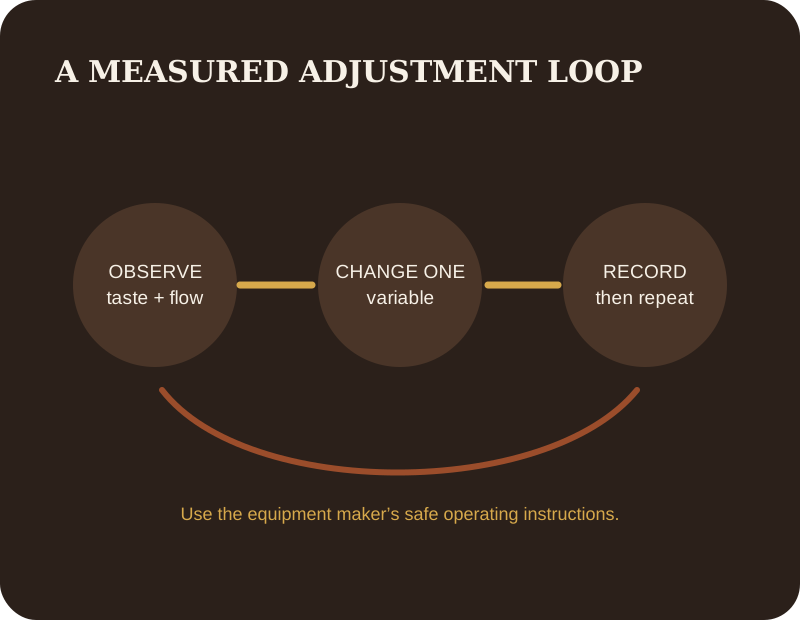
The practical sequence is to confirm the equipment is operating normally, record dose and beverage mass, describe the taste more precisely, repeat the preparation, and change one supported variable. That keeps troubleshooting evidence-safe and reversible.
Equipment boundary: Warm, operate, adjust, clean, and descale only as the exact machine and grinder manuals direct. Stay within basket and grinder limits. Stop recipe work for leaks, errors, abnormal noises, damaged components, or other service conditions.
Distinguish sourness from acidity
Acidity can be an intended and pleasant part of a coffee. “Sour” often describes an acidity that seems sharp, unbalanced, or empty, but language varies among tasters. Before changing the recipe, note the coffee’s available roast and flavor description and taste only when the beverage is safe.
Describe when the sensation appears and what accompanies it. Is the shot also thin, salty, hollow, drying, or very concentrated? Does sweetness appear as the cup cool? Is the finish short or persistent? These observations do not produce a laboratory analysis, but they are more actionable than a single label.
A bright coffee should not be forced to taste like a low-acidity coffee. The goal is a useful balance for the bean and intended drink, not elimination of every acidic impression.
Capture the baseline before touching the grinder
Record:
- coffee identity and available bag context;
- dry dose;
- grinder and local setting;
- basket and machine settings;
- puck preparation sequence;
- actual beverage mass;
- elapsed time and timing convention;
- machine warm-up or flushing state required by the manual;
- flow observations;
- maintenance and cleaning context;
- structured taste notes.
A target is not an actual result. If the shot stopped late, the dose differed, or preparation was interrupted, record what happened. The next decision should respond to the real shot.
Confirm normal machine state
A machine that is not ready, is displaying an alert, or has incorrectly seated components can confuse recipe diagnosis. Follow the documented warm-up and operating process. Confirm the reservoir, tray, basket, portafilter, and other user-serviceable parts are in their normal state.
Do not invent a long flush to change temperature. Heating systems differ, and a generic routine can waste water or conflict with the maker’s design. If temperature is user-adjustable, note the supported setting; otherwise treat it as an equipment parameter rather than an invitation to modify the machine.
Clean coffee-contact parts according to model instructions. Stale residue, a blocked basket, or poor reassembly can change both taste and flow. Descaling is a separate model-specific task and should not be performed simply because a shot tastes sour.
Check preparation consistency
An unevenly prepared puck can allow water to find easier paths, making part of the coffee contribute differently from the rest. Appearance can suggest uneven flow, but it does not quantify extraction. The useful response is to repeat a consistent preparation before changing the recipe.
Use the same dosing, distribution, and tamping sequence. Avoid chasing an unverified tamp-force number; focus on a level, repeatable process compatible with the basket. Confirm the portafilter locks in normally without signs of excessive fill.
If two shots made from the same written recipe behave very differently, solve repeatability first. A grind change cannot explain or correct a process that varies each round.
Read flow as one piece of evidence
A shot that reaches the beverage target much faster than a stable useful baseline may support testing a finer grind. A fine change commonly increases resistance in the basket. Yet low dose, poor distribution, grinder drift, or another preparation difference can also produce faster flow.
Elapsed time is therefore not an independent quality grade. Define the start and stop convention, record it consistently, and interpret it with dose, beverage mass, flow, and taste. Do not discard a pleasant shot solely because it misses a borrowed time number.
If flow is abnormal in ways the manual associates with a fault, switch from recipe work to equipment troubleshooting.
One-variable adjustment order
1. Repeat the baseline
Pull one more shot with the same measured dose, setting, puck preparation, and beverage mass. If the result changes substantially, refine preparation before changing the target recipe.
2. Test a finer grind
When flow is faster than the useful baseline and the cup is sharp or hollow, move slightly finer using the grinder’s approved procedure. Keep dose and beverage mass stable. Measure and taste again.
A very large move can overshoot and create a new problem. Small, recorded changes reveal direction. If the grinder setting seems ineffective, consider retained grounds only through a manufacturer-approved clearing method.
3. Test beverage mass
Once grind and preparation are stable, changing the stopping mass can test a different extraction and concentration relationship. Alter only that mass and record the result. Do not assume that a longer shot automatically fixes sourness; use the cup as evidence.
4. Consider supported machine settings
If the machine exposes a documented user setting and the coffee guidance makes it relevant, test one modest change. Keep the recipe otherwise stable. Never modify internal controls or exceed the manual to solve flavor.
Separate concentration from extraction
A concentrated shot can make acidity intense, while a dilute shot can taste thin. Grind and beverage mass interact with both concentration and extraction character. Ask which aspect is objectionable before choosing the lever.
If the cup is pleasantly flavored but simply too intense, test beverage concentration through a deliberate recipe or final-drink adjustment. If it is hollow and sharp relative to a stable baseline, a grind or extraction-length test may be more direct.
For drinks with milk or added water, evaluate the complete drink too. A bright straight espresso may behave differently in the intended beverage. Record additions separately so they are not confused with espresso beverage mass.
Troubleshoot persistent sourness
Work through this list one cause at a time:
- Coffee context: compare the note with the coffee’s expected bright character without assuming the bag guarantees taste.
- Actual recipe: verify dry dose and beverage mass rather than relying on memory.
- Grinder setting: confirm the control has not shifted and adjustment followed the manual.
- Puck preparation: repeat the same distribution and tamping sequence.
- Machine state: confirm normal warm-up, no alerts, and correct assembly.
- Cleanliness: clean approved coffee-contact parts; do not substitute a descale cycle.
- Cup and tasting: use a clean cup and compare at a safe, consistent point.
- One adjustment: choose grind or beverage mass, never both for the same test.
If several controlled changes fail to produce a useful cup, the coffee-equipment combination or personal preference may be the limiting context. That is a valid result, not a reason to invent a fault.
Sour espresso checklist
- Exact machine and grinder instructions checked
- Equipment operating normally
- Coffee-contact parts clean and correctly assembled
- Coffee identity recorded
- Dry dose measured
- Grinder setting recorded
- Beverage mass measured
- Time convention used consistently
- Puck preparation repeated
- Sourness separated from pleasant acidity and concentration
- One next variable selected
Brew log template
| Field | Entry |
|---|---|
| Date and coffee | |
| Machine, basket, and setting | |
| Dry dose | |
| Grinder and local setting | |
| Puck preparation | |
| Beverage mass | |
| Elapsed time and convention | |
| Flow observations | |
| Acidity, sourness, sweetness, texture | |
| Maintenance context | |
| One change from prior shot | |
| Result and next action |
Keep unsuccessful rows. They show which direction did not help under those conditions and reduce repeated guessing.
When not to keep adjusting
Stop when the shot is enjoyable and repeatable for its intended drink. A home recipe does not need to meet an external competition target. Save a useful range rather than treating one second or decimal as permanent.
Pause immediately if the grinder jams, the machine leaks, a warning appears, or operation differs from the manual. Flavor experiments should never be used to work around a mechanical issue.
Coffee can change with time and storage context. Recheck the baseline before assuming the machine or grinder has failed. Record cleaning, burr removal, calibration, or service events because they may shift the local setting.
Frequently asked questions
Does sour espresso always mean under-extraction?
No. Sourness can come from coffee character, concentration, inconsistent preparation, equipment state, or perception. Treat under-extraction as a hypothesis to test, not a verdict.
Should I grind finer?
A slightly finer setting is a reasonable controlled test when a measured shot runs faster than a useful baseline and tastes sharp or hollow. Keep dose and beverage mass stable and compare.
Should I pull a longer shot?
Changing beverage mass can test another recipe relationship, but do it separately from grind. The direction of improvement is coffee- and recipe-dependent.
Could the machine be too cold?
Temperature behavior may matter, but taste alone does not diagnose machine temperature. Follow warm-up instructions and use only documented user settings. Refer abnormal operation to support.
Why is only the first shot sour?
Machine state, warm-up, retained coffee, and preparation may differ. Document the sequence and follow the manual rather than inventing extra heating or flushing steps.
Is sour espresso unsafe?
Taste terminology alone cannot establish safety or equipment condition. Stop for spoilage concerns, chemical residue, damaged equipment, or abnormal operation and consult appropriate authoritative guidance.
Sources and decision limit
The existing Specialty Coffee Association reference provides standards and sensory context; it does not establish a universal sourness diagnosis, shot target, or machine compatibility claim. This workflow keeps changes measured and reversible and makes no firsthand-testing claim.